
If you spend most of your workday sitting at a desk, you’ve probably felt it — that nagging ache in your lower back, the tightness across your shoulders, or the stiffness that hits when you finally stand up at the end of the day. Here in West Fargo, ND, a growing number of patients come into Optimal Chiropractic with the same complaint: “I sit all day for work, and my back is killing me.” It’s one of the most common problems we see, and the cause might surprise you. The real culprit isn’t your chair. It’s what prolonged sitting does to your spine, your muscles, and your entire musculoskeletal system over time.
What does sitting all day actually do to your back?
Prolonged sitting places your spine in a sustained, compressed position that gradually disrupts the natural curves of your vertebral column. Over hours, this leads to muscle fatigue, disc pressure, and postural dysfunction that accumulates far faster than most people realize. It’s not a single bad chair causing your pain — it’s a pattern of inactivity and poor spinal loading that builds up day after day.
The Real Problem with Sitting All Day
Let’s be honest — most of us don’t think twice about how we sit. We drop into our chair, open our laptop, and get to work. Eight hours later, we’re stiff, sore, and wondering what went wrong. But here’s the thing: the human body was never designed to stay in one position for that long. Our spines are built for movement, and when we deprive them of it, problems start to develop.
The mistake most people make is assuming that if they just had a better chair — something more ergonomic, more cushioned, more adjustable — their back pain would go away. While a supportive chair certainly doesn’t hurt, it doesn’t solve the root problem. The issue is sustained, static loading on your spine. Even perfect posture, held for hours without a break, will eventually cause muscle fatigue and joint stress. No chair can fully compensate for that.
At Optimal Chiropractic in West Fargo, ND, Dr. Andrew Jahner and Dr. Nicholas Barney see this pattern constantly. Patients come in frustrated, having already tried new chairs, lumbar pillows, and standing desk converters — and while those tools have value, they’re only part of the solution. Understanding why sitting is hard on your body is the first step toward actually fixing the problem.
What Happens to Your Spine When You Sit for Hours
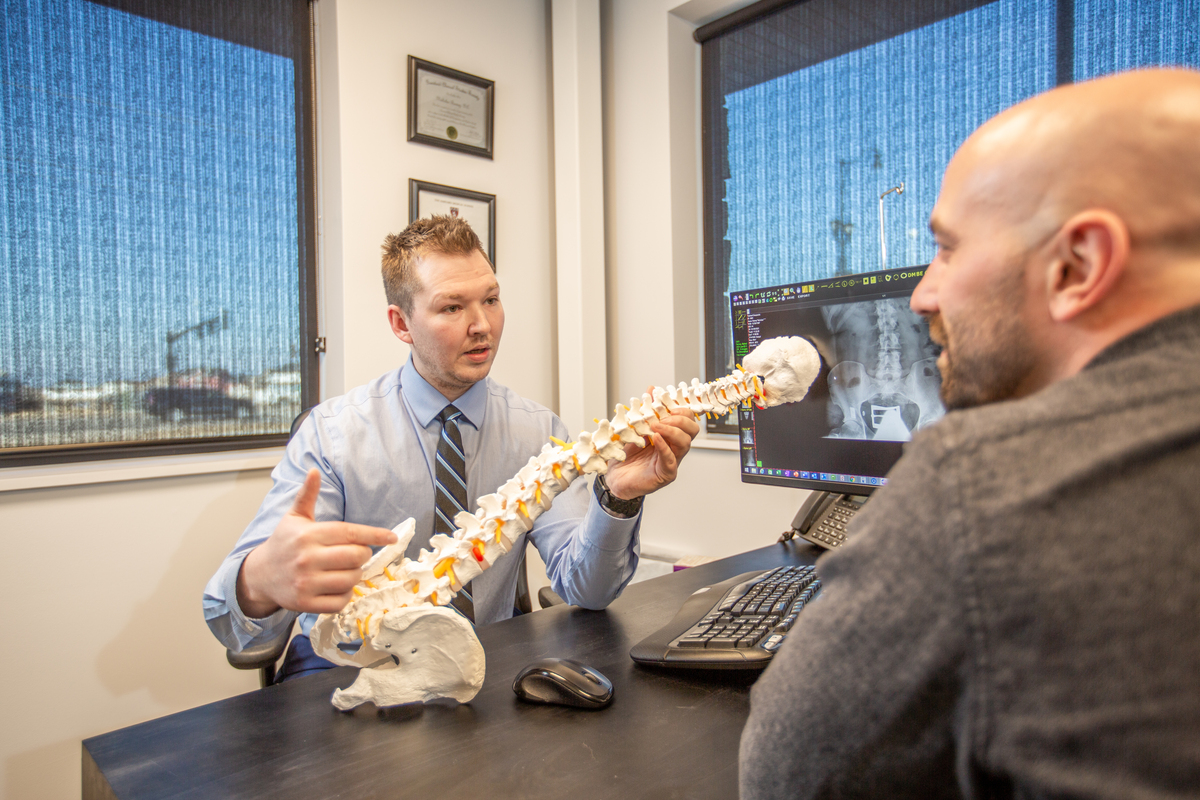
Your spine has three natural curves: a curve in the neck (cervical lordosis), a curve in the mid-back (thoracic kyphosis), and a curve in the lower back (lumbar lordosis). These curves work together like a spring system, absorbing shock and distributing load efficiently. When you sit — especially when you slouch — those curves flatten or reverse. That puts enormous pressure on your spinal discs and the surrounding joints.
Research published in the spine health literature consistently shows that intradiscal pressure — the pressure inside your spinal discs — is significantly higher when sitting than when standing or lying down. Over the course of an eight-hour workday, that sustained pressure can cause the discs between your vertebrae to compress and dehydrate. Discs rely on movement to stay hydrated and nourished, since they have no direct blood supply of their own. Extended sitting starves your discs of the fluid exchange they need to stay healthy.
Beyond the discs, your facet joints — the small joints along the back of each vertebra — can also become irritated and inflamed from prolonged static loading. Many patients who come to see Dr. Andrew Jahner or Dr. Nicholas Barney at Optimal Chiropractic don’t realize that the dull, deep ache they feel in their lower back is often coming from these joints, not from a pulled muscle. Without proper evaluation, it’s easy to misread the source of pain and miss effective treatment.
The Muscle Imbalances Nobody Talks About
Here’s what really drives long-term back problems in people with desk jobs: muscle imbalances. When you sit for hours every day, certain muscles get chronically shortened and tight — particularly your hip flexors, which run from your lower spine and pelvis down to your thighs. At the same time, other muscles become weak and inhibited from lack of use — especially your glutes and deep core stabilizers.
This imbalance has a name in the clinical world: Lower Crossed Syndrome. It describes a predictable pattern where tight hip flexors and lower back muscles pull your pelvis into an anterior tilt (forward), while weak glutes and abdominals fail to provide support. The result is an exaggerated lumbar curve, increased stress on the lower back joints, and pain that seems to persist no matter what you do.
The upper body doesn’t escape either. Extended time at a keyboard rounds the shoulders forward, tightens the chest muscles (pectorals), and weakens the muscles between your shoulder blades (rhomboids and mid-trapezius). This creates what’s often called Upper Crossed Syndrome — a pattern that leads to neck pain, headaches, and thoracic stiffness. Many patients in West Fargo, ND who sit at computers all day come into Optimal Chiropractic with both patterns happening simultaneously, compounding their discomfort significantly.
The key point here is that these are postural and muscular problems, not structural ones. That’s actually good news — because it means they’re addressable with the right approach.
How Chiropractic Care Fits Into the Picture
Chiropractic care is a natural, non-invasive approach that focuses on restoring proper movement and alignment to your spine and joints. When sitting-related back pain is present, the goal isn’t just to relieve the immediate ache — it’s to identify why the pain is occurring and address the underlying mechanical dysfunction that’s driving it.
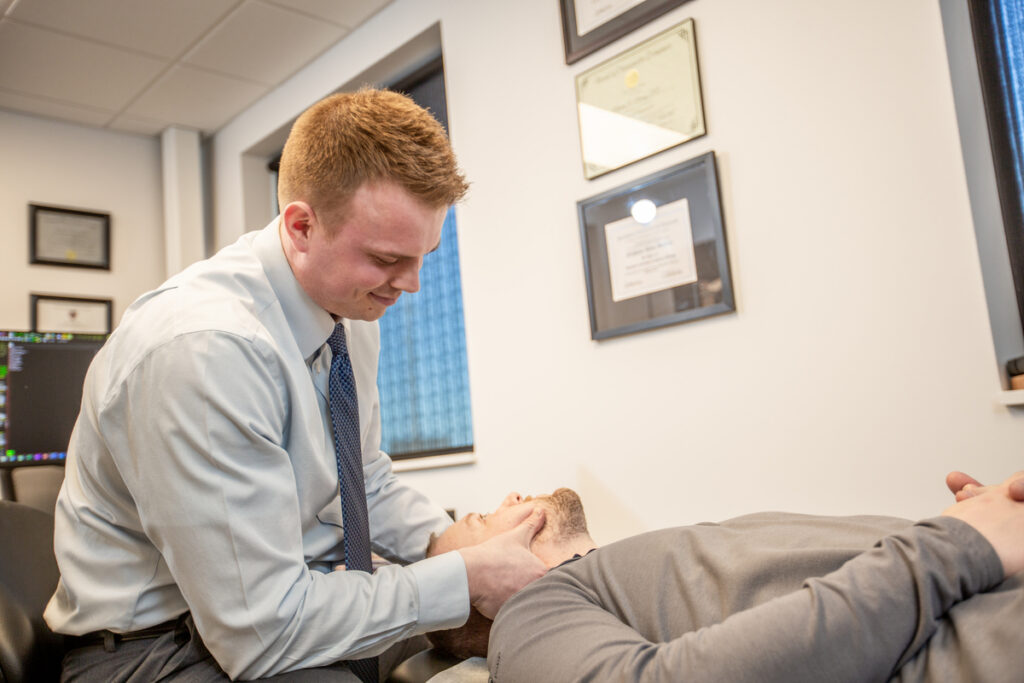
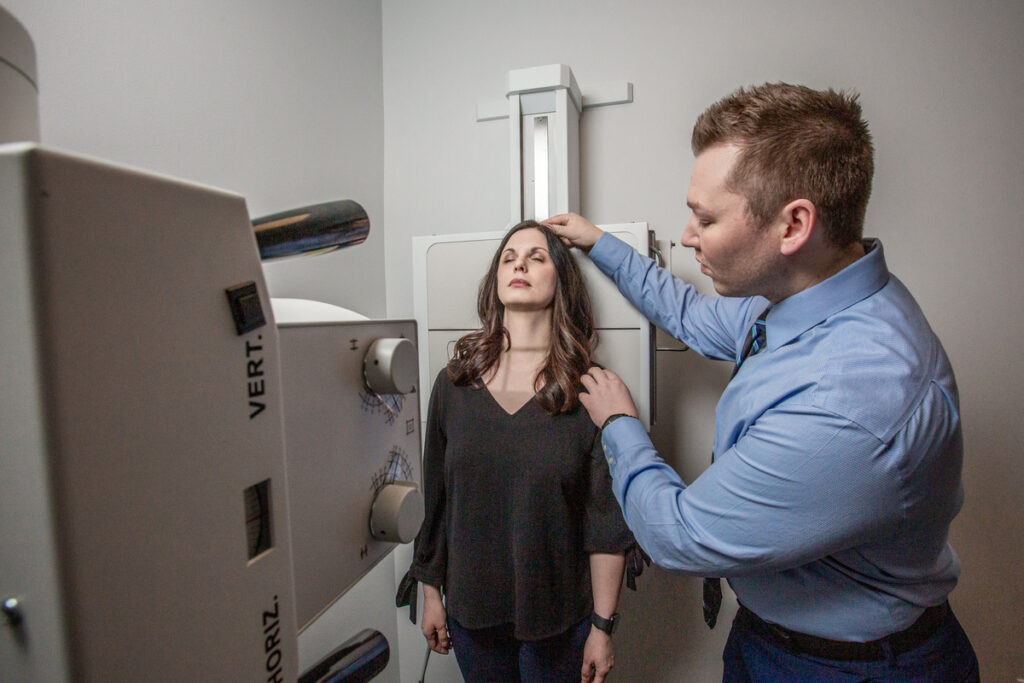
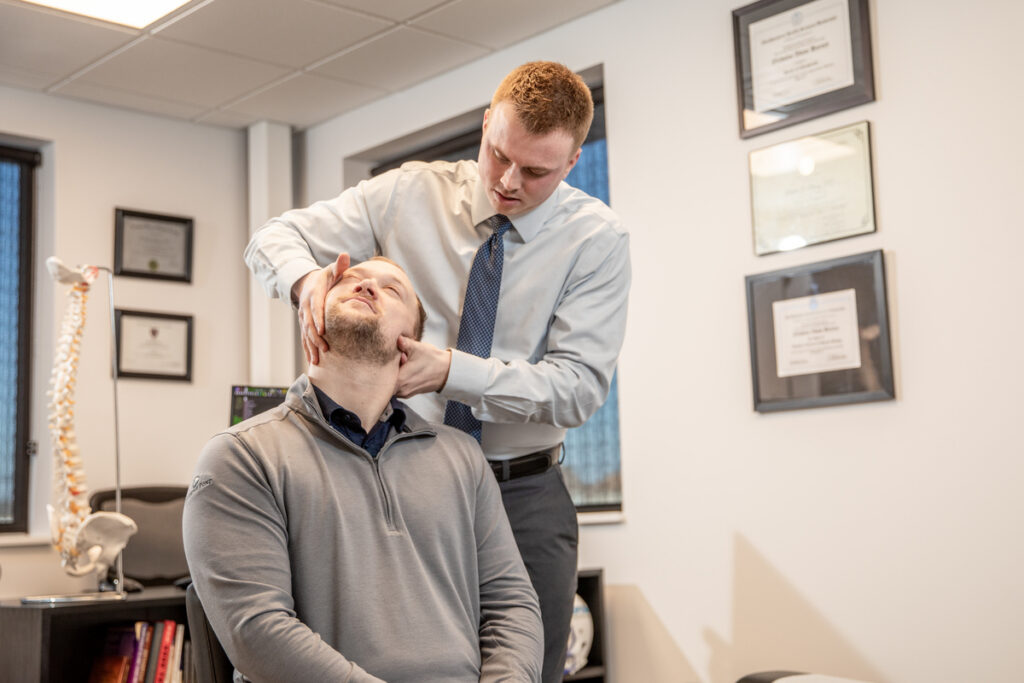
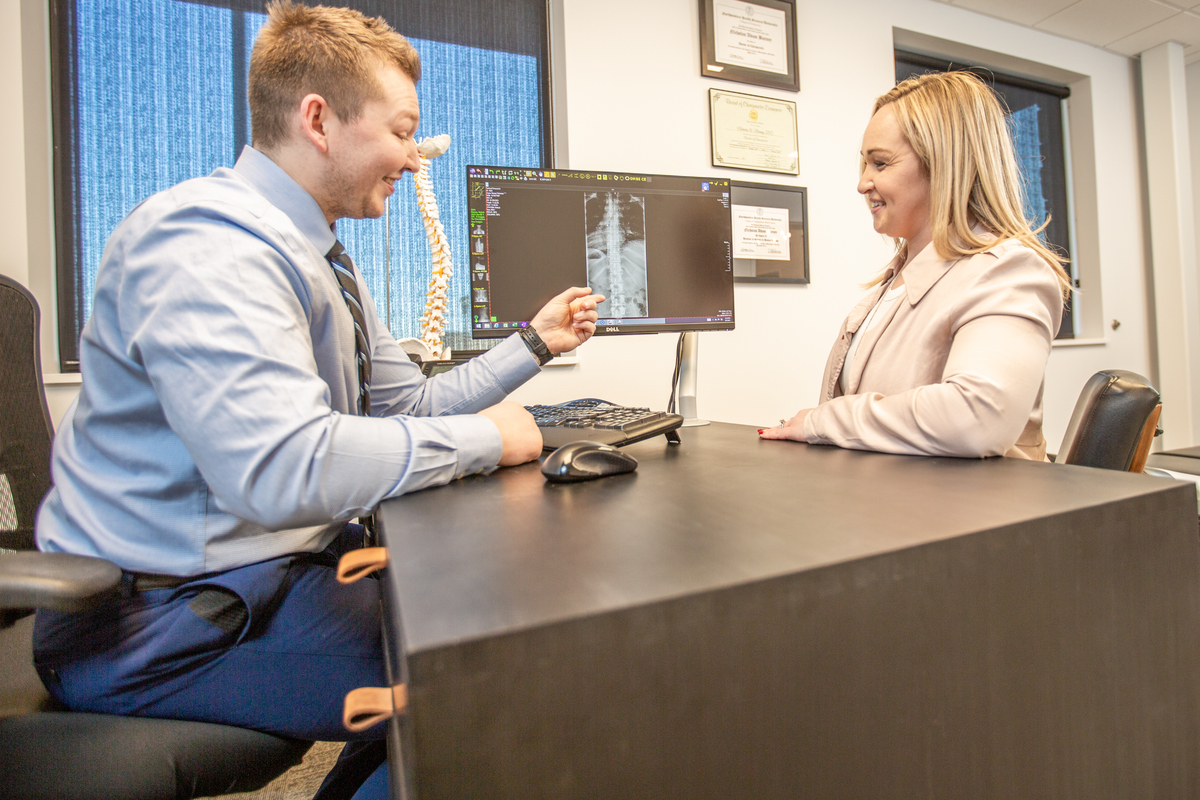
At Optimal Chiropractic in West Fargo, ND, Dr. Andrew Jahner and Dr. Nicholas Barney take a thorough, individualized approach to evaluating each patient’s spine and posture. A chiropractic adjustment helps restore normal motion to restricted spinal segments, which can reduce joint irritation and improve nerve communication throughout the body. This isn’t about “cracking your back” for the sake of it — it’s about restoring the biomechanical function your spine needs to do its job properly.
Beyond adjustments, chiropractic care may incorporate soft tissue techniques, postural re-education, and guidance on movement habits and exercises that counteract the effects of prolonged sitting. Evidence from organizations like the National Center for Complementary and Integrative Health (NCCIH) and the American College of Physicians (ACP) supports spinal manipulation as a reasonable first-line conservative care option for lower back pain. It’s a drug-free, surgery-free path that works with your body rather than around it.
Many patients who start care at Optimal Chiropractic are surprised at how much better they feel once their spine is moving properly again — not just their back, but their energy, their concentration, and their ability to get through a workday without constant discomfort.
Practical Tips to Protect Your Back at Work
While professional chiropractic care can make a significant difference, there are also practical steps you can take every single day to reduce the strain sitting places on your spine. These aren’t complicated — they’re small, consistent habits that add up over time.
The most important thing you can do is move more frequently. Research suggests that breaking up prolonged sitting with short movement breaks every 30 to 45 minutes can meaningfully reduce the biomechanical stress on your spinal discs and joints. You don’t need a full workout — even standing up, walking to the water cooler, or doing a brief stretch for 60 seconds can reset your posture and give your muscles and discs a chance to recover.
Hip flexor stretches are particularly valuable for desk workers. A simple kneeling hip flexor stretch held for 30 seconds on each side can begin to counteract the tightening that accumulates from hours of sitting. Thoracic extension exercises — gently arching your upper back over the back of your chair or a foam roller — can help restore the natural curve in your mid-back and relieve tension across the shoulders.
Pay attention to your monitor height and head position as well. Your screen should be roughly at eye level so your head isn’t tilting down or craning forward. Every inch your head moves forward of your shoulders adds significant extra load to your cervical spine — a concept sometimes referred to as “tech neck.” This small adjustment alone can make a meaningful difference in neck and upper back discomfort for many patients in West Fargo, ND.
When to See a Chiropractor
Not all back pain from sitting is the same, and it’s worth knowing when it makes sense to seek professional care rather than waiting it out. If you’ve had nagging lower back stiffness or pain that’s been present for more than a couple of weeks and isn’t improving with rest or movement breaks, that’s a good signal that your body needs some help. Persistent pain that interferes with your ability to concentrate at work, sleep at night, or enjoy activities outside the office is another clear sign it’s time to get evaluated.
Dr. Andrew Jahner and Dr. Nicholas Barney at Optimal Chiropractic in West Fargo, ND can assess your spinal alignment, identify restricted joints, and evaluate the muscle imbalances that may be contributing to your pain. Early care often leads to faster resolution and helps prevent a manageable problem from becoming a chronic one.
There are also certain red flags that warrant prompt medical attention rather than chiropractic care — or alongside it. These include back pain accompanied by numbness or tingling that radiates down one or both legs, loss of bladder or bowel control, unexplained weight loss, or pain following a fall or trauma. In these situations, it’s important to seek medical evaluation right away. A good chiropractor will always refer out when a situation falls outside the chiropractic scope of care, and that’s exactly the approach taken at Optimal Chiropractic.
Sitting Habits: What Hurts vs. What Helps
|
Habit |
What Hurts Your Back |
What Helps Your Back |
|---|---|---|
|
Sitting Duration |
Sitting for 2+ hours without a break |
Standing or moving for 1-2 minutes every 30-45 minutes |
|
Monitor Position |
Screen too low, causing head-forward posture |
Screen at eye level to keep neck in a neutral position |
|
Lumbar Support |
Slouching into the lower back, flattening lumbar curve |
Maintaining a slight arch in the lower back with support |
|
Hip Position |
Crossing legs or tucking pelvis under |
Feet flat on the floor, hips at approximately 90 degrees |
|
Upper Body |
Rounded shoulders and forward head while typing |
Shoulders back and relaxed, elbows close to the body |
|
Stretching Habits |
No stretching or movement throughout the day |
Daily hip flexor and thoracic extension stretches |
Myths vs. Facts About Sitting and Back Pain
Myth: A Better Chair Will Fix My Back Pain
Fact: While an ergonomic chair can reduce some strain, no chair eliminates the fundamental problem of sustained, static loading on the spine. The missing ingredient is movement. Even the best chair in the world can’t fully compensate for sitting in one position for eight hours without breaks.
Myth: If I Have Good Posture, Sitting All Day Is Fine
Fact: Good posture is important, but even a biomechanically ideal seated position becomes problematic when held for too long. Your muscles fatigue, your discs are still under elevated pressure, and your hip flexors are still shortening. Posture matters — but movement matters more.
Myth: Back Pain from Sitting Is Just Part of Getting Older
Fact: Age-related changes in the spine do occur, but sitting-related back pain is largely driven by modifiable factors — muscle imbalances, joint restriction, and prolonged inactivity. People of all ages can develop and recover from this type of pain. Many patients at Optimal Chiropractic in West Fargo, ND in their 30s and 40s experience significant improvement with appropriate care.
Myth: I Should Rest and Avoid Activity When My Back Hurts
Fact: The evidence is quite clear here — prolonged bed rest is not recommended for most back pain. Gentle, controlled movement actually promotes disc hydration, reduces muscle stiffness, and supports recovery. Rest has a role, but staying too still for too long typically makes sitting-related back pain worse, not better.
Myth: Standing Desks Solve the Problem Completely
Fact: Standing desks are a helpful tool, but standing all day has its own set of problems — including fatigue, vascular pooling in the legs, and lower back strain from prolonged static standing. The real goal is alternating between positions and incorporating regular movement. A standing desk is a great addition to that strategy, not a replacement for it.
Final Thoughts from Optimal Chiropractic
Back pain from a desk job is incredibly common — but it’s not inevitable, and it doesn’t have to be permanent. The more you understand about why sitting places stress on your spine, the better equipped you are to make small, meaningful changes that protect your back for the long haul. Movement breaks, postural awareness, and targeted stretching can make a real difference in how your body feels at the end of the workday.
Here in West Fargo, ND, the team at Optimal Chiropractic — including Dr. Andrew Jahner and Dr. Nicholas Barney — is here to help you get to the root of what’s driving your discomfort. Whether you’ve been dealing with chronic lower back pain for years or you’re just starting to notice the effects of long hours at your desk, a thorough evaluation can give you real answers and a clear path forward. Chiropractic care is a safe, evidence-informed, and compassionate approach to helping you feel better and move well — and that’s exactly what you’ll find at Optimal Chiropractic.
You don’t have to just live with it. Your back has a lot of good years left in it — and with the right support, you can keep it that way.
Frequently Asked Questions
How long does it take for sitting-related back pain to improve with chiropractic care?
The timeline varies depending on how long the problem has been present, the degree of muscle imbalance, and how consistently you implement lifestyle changes alongside care. Many patients begin to notice meaningful improvement within a few weeks of starting regular chiropractic adjustments, though more chronic cases may take longer to fully resolve.
Is it normal to feel stiff in the morning if I sit all day for work?
Morning stiffness that follows prolonged sitting during the day is very common and often reflects disc dehydration and muscular tightening that accumulated over time. It’s not necessarily “normal” in the sense that it should be ignored — it’s a signal that your spine isn’t moving and recovering as efficiently as it should be. A chiropractic evaluation can help identify why.
Can chiropractic care help with neck pain from looking at a screen all day?
Yes — neck pain related to sustained forward head posture and screen time is one of the most common complaints treated at chiropractic offices. Adjustments to the cervical spine, along with guidance on monitor positioning and postural habits, can help significantly reduce this type of neck discomfort.
How often should I take breaks from sitting at my desk?
A general guideline supported by musculoskeletal health research is to take a brief movement break every 30 to 45 minutes. Even one to two minutes of standing, walking, or gentle stretching can meaningfully reduce the cumulative strain on your spinal discs and surrounding muscles throughout the day.
Does chiropractic care involve more than just adjustments for back pain?
Absolutely. At Optimal Chiropractic in West Fargo, ND, care for sitting-related back pain may also include soft tissue work, postural re-education, exercise recommendations, and ergonomic guidance. The goal is to address the full picture — not just provide temporary relief, but to help you build habits that support long-term spinal health.
What if my back pain is accompanied by leg pain or numbness?
Pain, tingling, or numbness that radiates down one or both legs can indicate nerve involvement — such as sciatic nerve irritation — which warrants a prompt evaluation. Dr. Andrew Jahner and Dr. Nicholas Barney at Optimal Chiropractic are trained to assess these presentations and determine the most appropriate course of care, including referral if necessary.
TL;DR
-
Sitting for eight hours a day places sustained compressive stress on your spinal discs and joints — and no chair fully solves this problem on its own.
-
Prolonged sitting leads to predictable muscle imbalances (tight hip flexors, weak glutes and core) that drive chronic lower back pain over time.
-
Taking movement breaks every 30 to 45 minutes, maintaining eye-level screen height, and incorporating daily stretching are practical steps that make a real difference.
-
Chiropractic care from Dr. Andrew Jahner and Dr. Nicholas Barney at Optimal Chiropractic in West Fargo, ND can help restore proper spinal movement, address underlying dysfunction, and reduce pain without drugs or surgery.
-
If your back pain has lasted more than a couple of weeks or is affecting your daily life, it’s worth getting a professional evaluation sooner rather than later.